Skip to content

The soldier crouches in a trench. Somewhere ahead — separated by a stretch of cratered ground, barbed wire, and enemy fire — is a target that needs to be destroyed. Sending a person would mean almost certain death.
So instead, he picks up a cable reel and a joystick.
This scene did not happen in 2024. It happened in 1916.
The idea of sending an unmanned vehicle into danger — something that can carry a weapon, cross hostile ground, and strike a target without a human operator inside — is not a product of Silicon Valley or the age of AI. It is at least a century old. And tracing that history reveals something remarkable: the engineers of today’s battlefield robots are solving the exact same problems their predecessors faced, just with better tools.
The Question That Never Changed
Before there were robots, there were fire carts.
Ancient armies used incendiary wagons — wooden platforms loaded with combustibles, pushed or guided toward enemy formations. They were not controlled in any meaningful sense. They were aimed, released, and left to chance. Medieval naval commanders refined the concept with fireships: vessels packed with burning material and steered toward enemy fleets, their skeleton crews abandoning ship at the last possible moment.
The logic was always the same: put destructive capability exactly where it needs to be, without putting a person there.
Ukrainian military tradition offers its own version of this instinct. The Cossacks built the tabir — a mobile fortified camp constructed from wagons, reorganizable on the move, capable of projecting force while protecting its people behind a wall of wheels and timber. Historians draw a direct line between this kind of modular, mobile battlefield architecture and the principles behind modern autonomous combat systems. The technology is different. The question is identical.
What changed the equation was industrialization — and the particular horror of the Western Front.
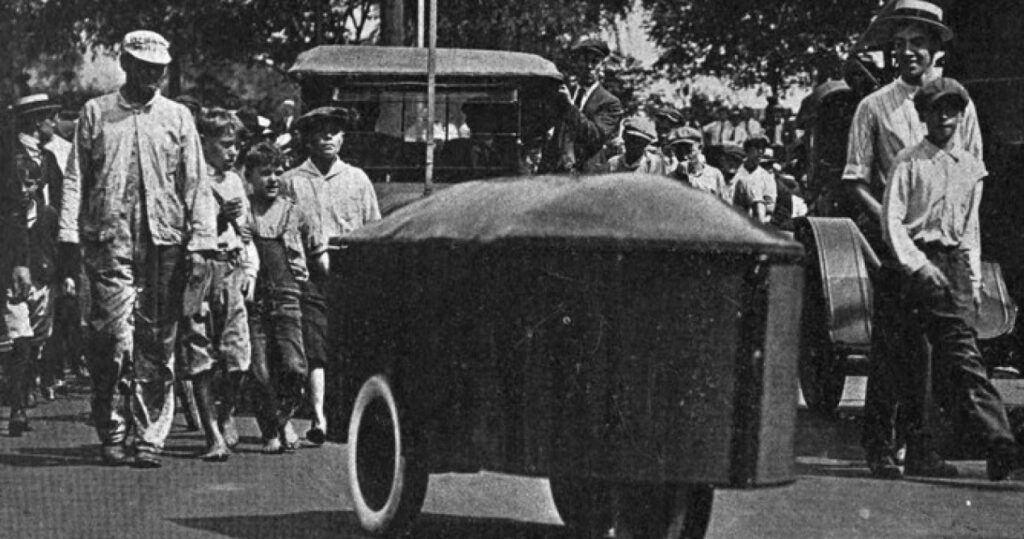
World War I: The First True UGVs
Trench warfare created a demand that no existing weapon could satisfy. The ground between the lines was churned beyond recognition by artillery, threaded with barbed wire, covered by interlocking fields of fire. Sending infantry across it was catastrophic. What the engineers of 1915 needed was something that could cross that ground without a person inside it.
They called their solutions land torpedoes or self-propelled mines. We would call them unmanned ground vehicles.
The guidance problem was immediate. Radio technology existed but was unreliable and bulky. The solution was wire: an electrical cable connecting the operator to the vehicle, carrying steering commands and — when the moment came — a detonation signal.
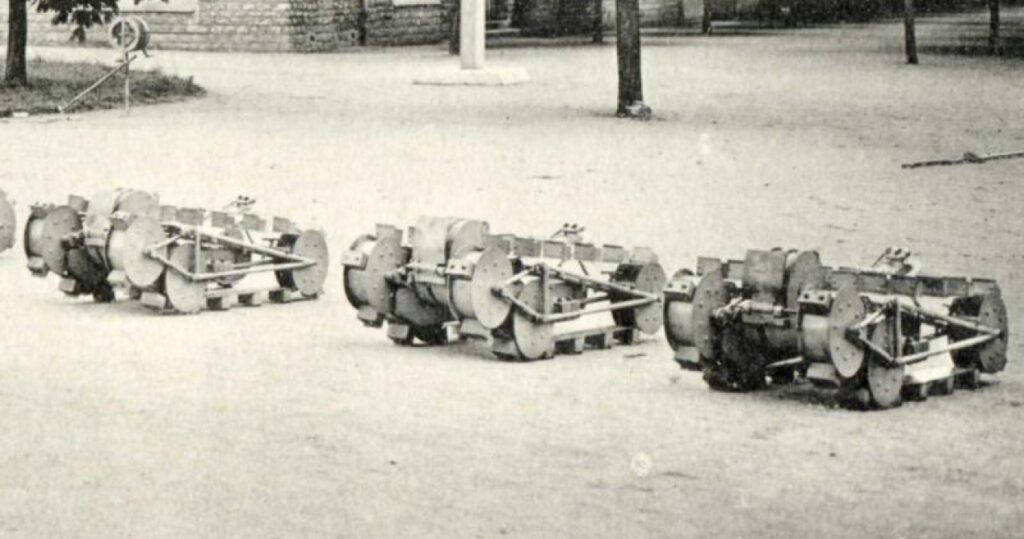
The Crocodile Schneider (France, 1915–1916)
France led the early development. The Crocodile Schneider, also called Torpille Terrestre, carried a 40 kg explosive charge on a tracked chassis and was guided by a trailing wire. It offered three-position directional control: straight, left, or right. Eleven units were produced. It saw limited field trials in June 1916 — making it arguably the first remotely operated ground weapon ever tested in actual combat conditions.
It performed poorly. The terrain was too difficult, the guidance too crude, and within months the first tanks appeared and drew away most of the military’s attention. But the concept had been demonstrated.
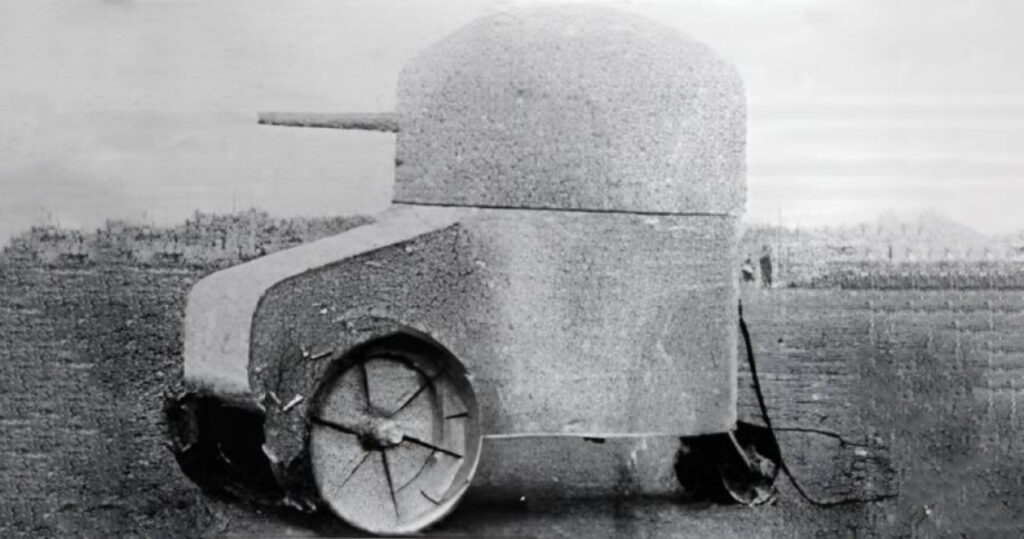
The Aubriot-Gabet Electric Torpedo (France, 1915)
A parallel French project, the Aubriot-Gabet, was driven by a single electric motor powered through its trailing cable. Early versions may have lacked steering entirely — its designers reasoned that it simply needed to cross no man’s land and detonate against the long continuous trench lines of the enemy. Aim it, send it forward, and let it find something to hit.
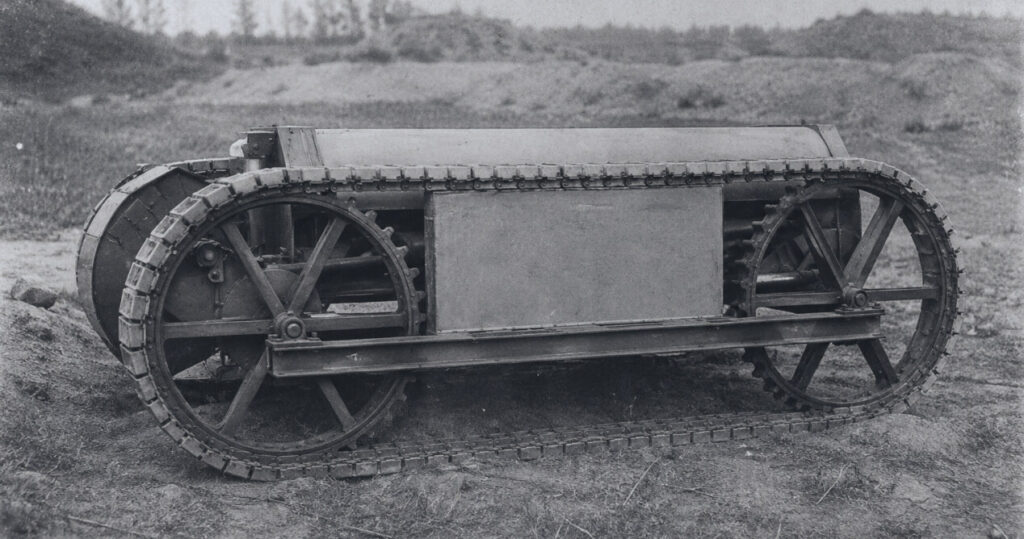
The Wickersham Land Torpedo (USA, 1918)
On the other side of the Atlantic, American inventor Elmer Wickersham patented his Land Torpedo in 1918. Its design was nearly identical to the European models: tracked chassis, wire guidance, explosive payload. Engineers working independently, separated by an ocean and without knowledge of each other’s work, had converged on the same solution to the same problem.
The tracked, wire-guided, explosive-carrying unmanned vehicle was not one man’s invention. It was an idea whose time had come.
The “Human Mavic” Problem
Every operator of these early systems faced the same maddening limitation: there was no camera.
Modern drone pilots navigate through a live video feed. Their World War I counterparts had no such option. The operator sat in a trench, held a joystick connected by cable to a vehicle somewhere in the smoke and mud, and had to rely entirely on direct line of sight to know where it was going.
In the shell-cratered landscape of the Western Front, direct line of sight was rarely available. The terrain that made these weapons necessary was exactly the terrain that made them nearly impossible to guide accurately.
The improvised solution was a human observer — what one might today call a “human Mavic.” A spotter was positioned somewhere with better visibility and shouted corrections to the operator: Left. Right. Straight. Stop. He was, in every functional sense, the camera and display system rolled into one exposed person on a battlefield.
Some units used artillery spotters for this role. There are documented accounts of concealed observation posts built inside artificial trees — hollow structures where observers with binoculars and early radio sets would track the vehicle’s movement and relay corrections back to the operator.
It worked. Sometimes. When the cable didn’t get cut by artillery.
The Telekino Precedent (1903)
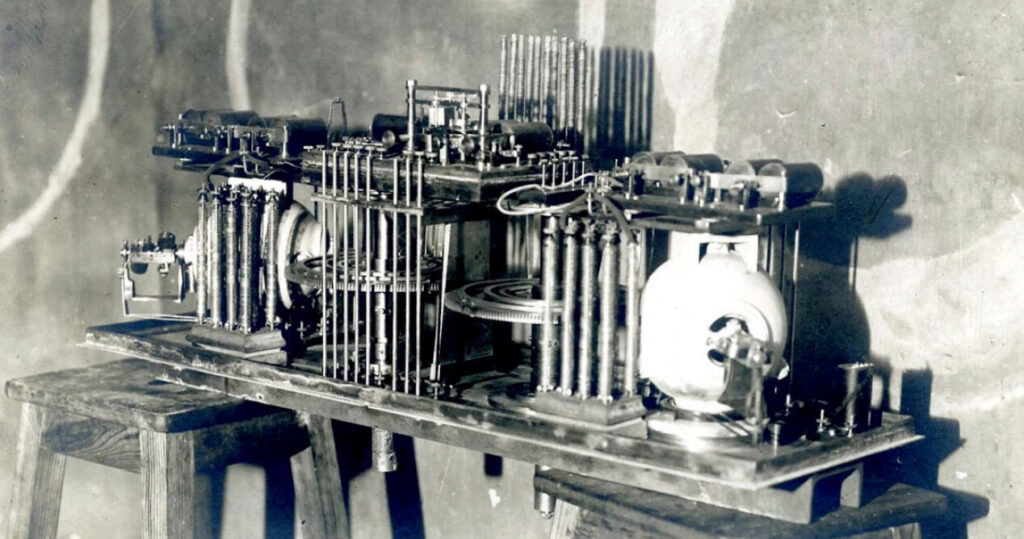
The engineers of 1915 knew that wireless guidance was theoretically possible. In 1903, Spanish engineer Leonardo Torres Quevedo had publicly demonstrated his Telekino system — a device that used wireless telegraph principles to control a boat remotely, without any physical connection. He patented it in France, Spain, and the United States.
Wireless was possible. Battlefield conditions simply made it impractical. The wire remained the only reliable option — a constraint that would persist until the next world war.
The French Engineer Who Accidentally Gave Germany Its Most Famous Robot
In the 1930s, a French engineer named Adolphe Kégresse was working on a miniature tracked vehicle — a further development of the Crocodile concept. Kégresse was already one of Europe’s most accomplished vehicle designers: he had served as personal chauffeur and head of the imperial garage for Tsar Nicholas II, inventing the Kégresse rubber track system that made half-tracks possible. He later collaborated with Citroën, led famous trans-African expeditions, and developed the dual-clutch transmission decades before it became standard in modern cars.
His miniature tracked vehicle prototype was, by 1940, nearly complete.
When Germany invaded France in June 1940, Kégresse made a decision. Rather than let the prototype fall into enemy hands, he threw it into the River Seine.
The Wehrmacht found it anyway. Engineers recovered the prototype, studied it carefully, and within weeks had issued a contract to the Borgward automotive company of Bremen to develop a similar vehicle capable of carrying at least 50 kg of explosives to a target by remote control.
The result, introduced in 1942, was the Goliath.
World War II: From Prototype to Production
The Goliath (SdKfz 302/303)
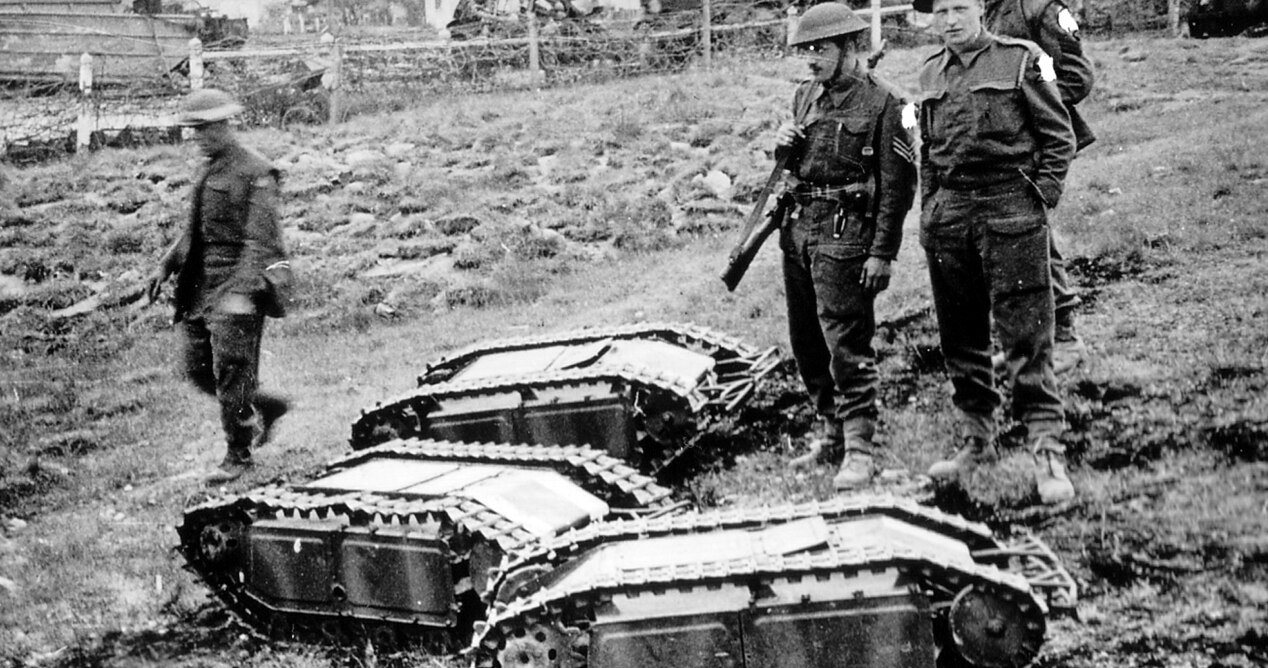
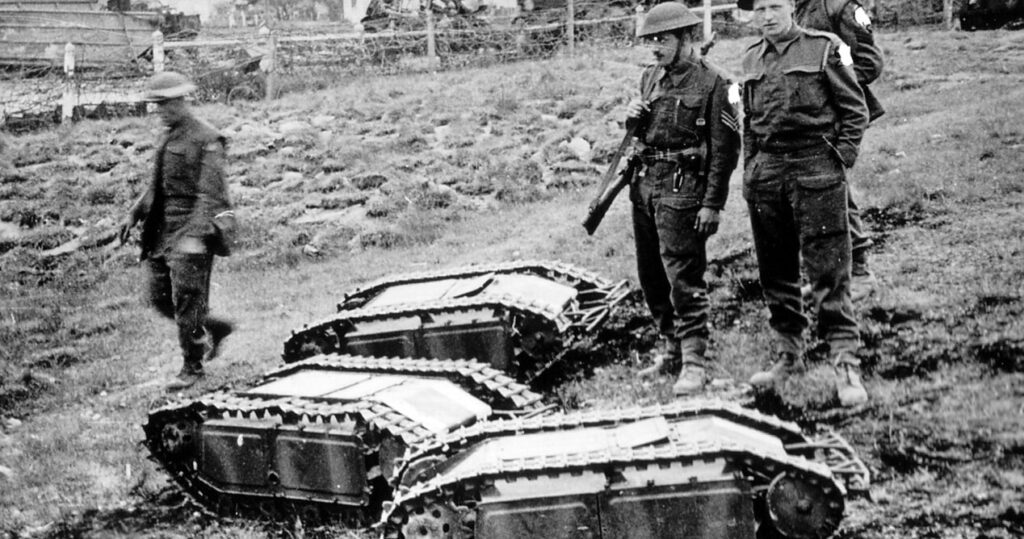
The Goliath was small — roughly 1.5 meters long, 0.85 meters wide, 0.56 meters tall. Allied soldiers who captured them called them “beetle tanks.” The name was accurate. They looked like oversized mechanical insects.
There were two main variants:
- SdKfz 302: electrically powered, carried 60 kg of explosives. Cost 3,000 Reichsmarks per unit — expensive, difficult to maintain and recharge in the field.
- SdKfz 303a/303b: switched to a cheaper two-stroke petrol engine, carried 100 kg of explosives, range of over 11 km on road.
Control came through a joystick connected to the vehicle by a 650-meter triple-strand cable. Two strands handled steering and movement; the third triggered detonation. The cable drum was stored in the vehicle’s rear compartment, unspooling as it advanced.
The Goliath was deployed on every front where the Wehrmacht fought, from 1942 onward. It saw action at Anzio in Italy (April 1944), on the beaches of Normandy during D-Day, in the Maritime Alps, and most notably during the Warsaw Uprising of 1944 — where Polish resistance fighters learned quickly that cutting the control cable was enough to neutralize it.
At Normandy, artillery blasts severed command cables and rendered most Goliaths inoperative before they reached their targets.
A total of 7,564 Goliaths were produced. Despite the numbers, the weapon was not considered a success. High unit cost, low speed (just above 6 km/h), minimal ground clearance (11.4 cm), vulnerable cable, and thin armor that couldn’t stop small arms fire meant that most failed to reach their targets.
Captured Goliaths were examined with interest by Allied intelligence but deemed to have little military value. The US Army Air Force used some as aircraft tugs — until they broke down, because a disposable single-use vehicle was not built for sustained operation.
The Borgward Family: Mine Clearance to Demolition
While the Goliath was small and disposable, the Borgward series represented a parallel, heavier line of development aimed at mine clearance and fortification demolition.
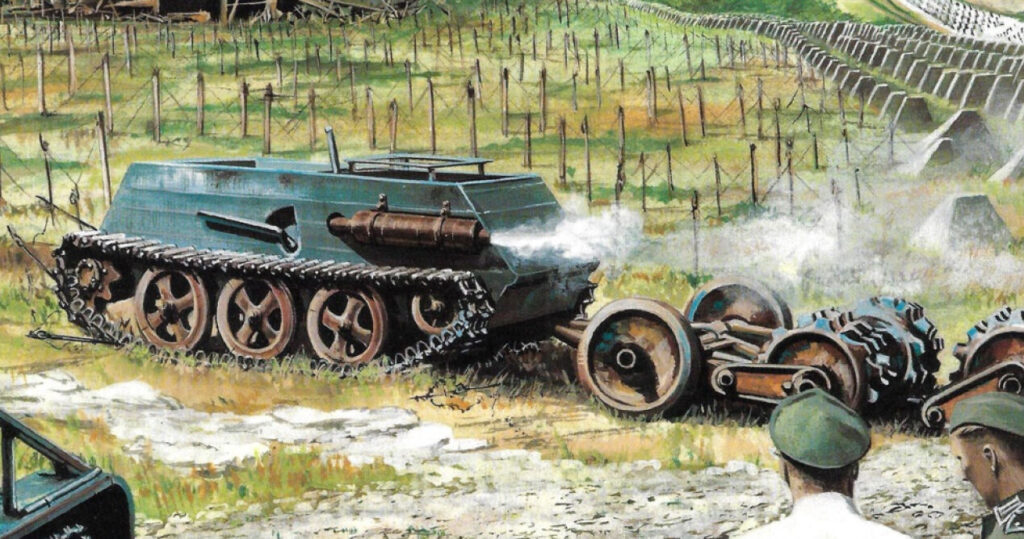
The program began in late 1939 with the B1 (SdKfz 300) — a concrete-hulled tracked vehicle that towed rows of mine rollers to detonate buried mines by pressure. The first 50 units were delivered in early-to-mid 1940, many without their radio control hardware. Most were destroyed clearing mines around France’s Maginot Line.
The B2 followed with an experimental approach: fit the vehicle with its own explosive charge, drive it into a minefield, and detonate — hoping the explosion would trigger a chain reaction in surrounding mines. This concept, called sympathetic detonation, was tested on the Eastern Front in 1941. It didn’t work reliably either.
The logical next step was to abandon mine clearance entirely and use these vehicles purely for demolition missions against bunkers, fortifications, and anything else that needed destroying.
The result was the B4 (SdKfz 301), produced in the fall of 1941. It was a fundamentally different machine from its predecessors:
- Full steel hull (versus the B1’s concrete superstructure)
- Six-cylinder engine
- 450 kg deployable explosive box mounted on the front, attached with explosive bolts
- When deployed, the operator triggered the bolts remotely; the box disconnected and slid forward off the vehicle
- Armor: 10 mm front, 5–8 mm sides, 2–3 mm roof
- Torsion bar suspension
- Radio-controlled: commands received by the vehicle were converted by onboard hydraulic and electrical systems into mechanical steering inputs
The B4 required a dedicated command vehicle. Early in the program, this was a converted Panzer I derivative. By the time of the B4, it was a Panzer III — and eventually, Tiger I and Tiger II heavy tanks were pressed into the operator role. The Tiger crews, understandably, were not pleased to find their 57-tonne battle tanks repurposed as remote-control consoles.
The B4 also spawned experimental variants that read almost like a catalog of modern UGV concepts: a version fitted with a television camera for unmanned reconnaissance; a version with floatation equipment tested in the Baltic Sea; versions equipped with smoke dispensers; and — at the very end of the war — 56 units fitted with six Panzerschreck rocket launchers each, serving as improvised unmanned tank destroyers.
The Springer (SdKfz 304)
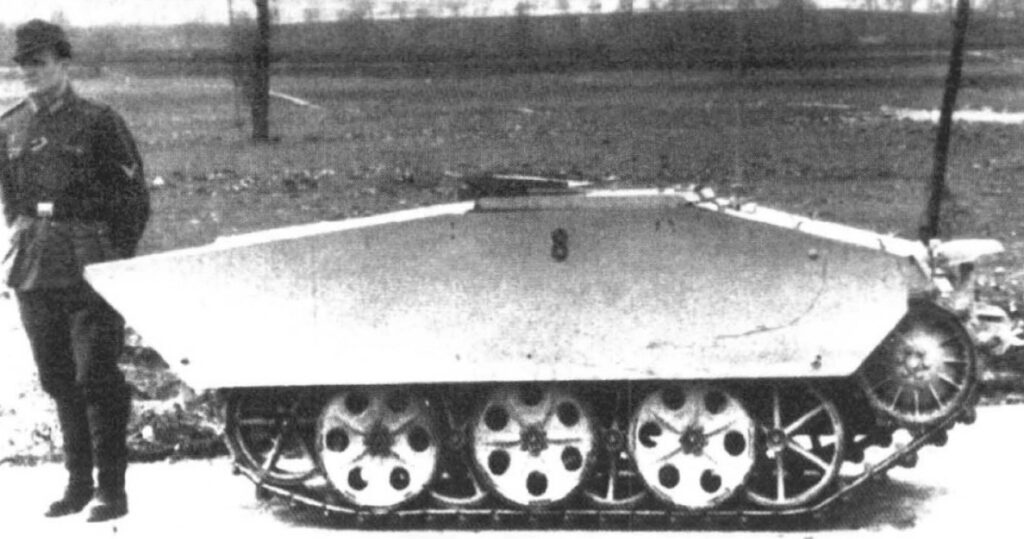
Entering production in fall 1944, the Springer was designed by NSU — the same company that made the Kettenkrad — and used many of its parts. It served as a medium-weight complement to the heavy B4, carrying a fixed 300 kg charge. Like the Goliath, it was single-use. Unlike the Goliath, it was radio-controlled rather than wire-guided — a significant technical step forward that reflected the improving reliability of battlefield radio by the war’s end.
The Pattern That Repeats
Stand back and look at the full arc from 1916 to 1945, and the same problems keep appearing:
Guidance — wire is reliable but fragile; wireless is robust but technically difficult. Every generation of UGV engineers has traded off between these two poles, and the balance has shifted as radio and digital technology matured.
Visibility — the operator needs to know where the vehicle is and what it’s facing. The “human Mavic” solution of WWI was replaced by the Borgward B4’s experimental television camera in WWII. Today it’s a live HD feed with thermal imaging.
Cost versus expendability — the Goliath was disposable but expensive. The B4 was reusable (it dropped its charge and could return) but required far greater investment. Modern UGV designers face exactly the same tradeoff.
Integration with manned systems — the Tiger tanks pressed into service as Borgward command vehicles represent an early, awkward attempt at manned-unmanned teaming. Today, this concept is at the center of every major military’s robotics doctrine.
Technology has transformed. The questions have not.
Ukraine and the Living Laboratory
Ukraine’s Victory Robots program sits at the far end of this century-long lineage.
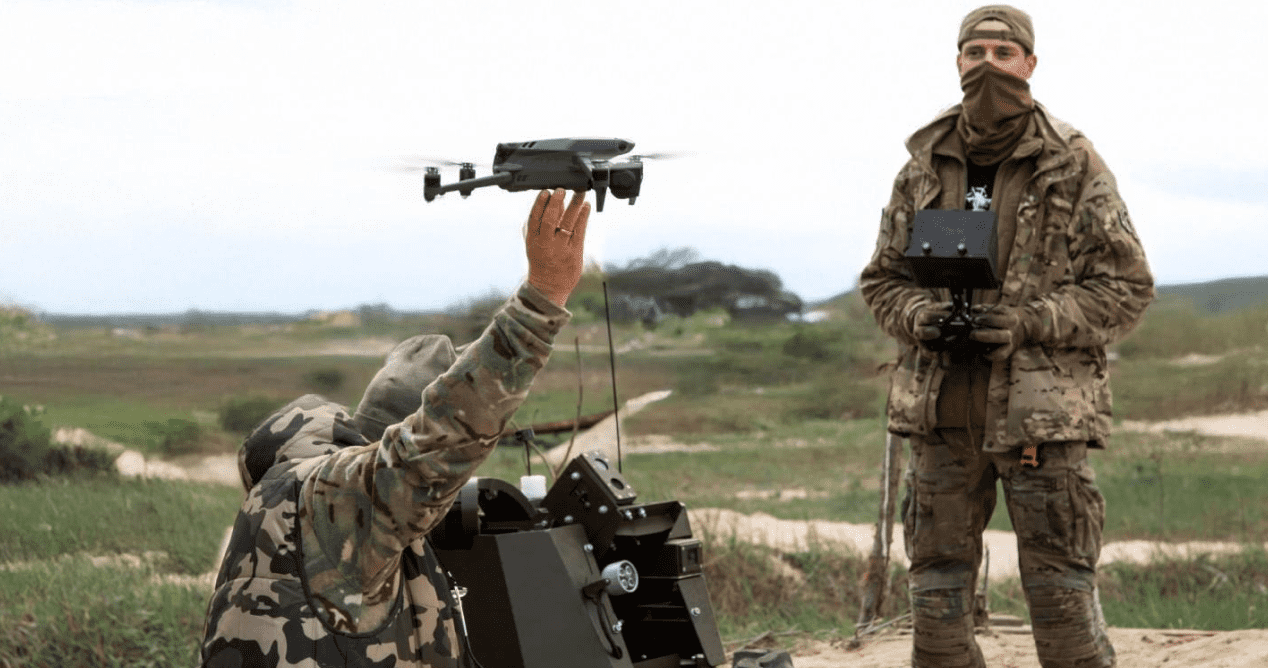
Where the Crocodile Schneider’s operator shouted commands to a human spotter 300 meters away, today’s Ukrainian UGV operators navigate through live video feeds on tablets and laptops. Where the Borgward B4 required a Tiger tank as its command vehicle, modern Ukrainian ground robots are controlled from concealed positions with encrypted digital links.
But the missions are recognizable. Logistics under fire. Evacuation of wounded from positions too dangerous for human medics. Assault on fortified positions. Reconnaissance into areas where sending a person would mean near-certain loss.
This is not science fiction. It is the direct descendant of an 11-unit field trial in France in June 1916.
Conclusion: The Cycle Continues
Military technology moves in cycles. The same needs generate the same solutions, refined by whatever tools each generation has available.
The engineers of 1915 who built the Crocodile Schneider were asking the same question that Dignitas Ukraine’s Victory Robots program asks today: how do you accomplish a mission that would kill a person, without killing a person?
They had wire reels and simple clutch mechanisms. We have microprocessors, encrypted datalinks, and machine learning. The answers are better. The question is unchanged.
Adolphe Kégresse threw his prototype into the Seine to keep it from the enemy. The enemy pulled it out and built 7,564 copies of it. A century later, Ukraine is building the next generation of that idea — not as a disposable explosive carrier, but as a platform for evacuation, logistics, reconnaissance, operated by trained specialists from concealed positions.
The Crocodile Schneider’s three-position joystick is still there, somewhere in the design. It just looks different now.