Skip to content

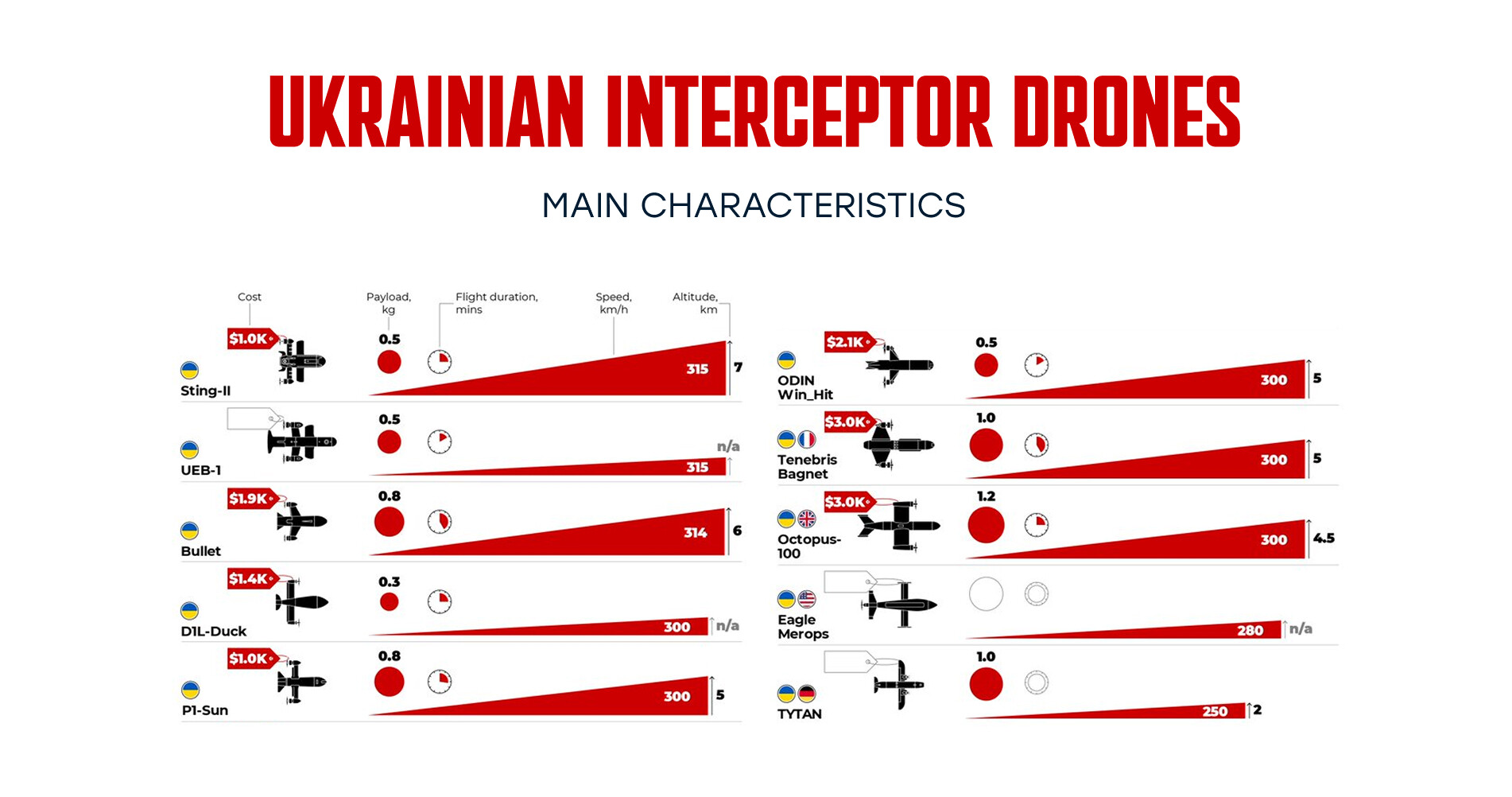
Key characteristics of Ukrainian interceptor drones: cost, warhead weight, flight duration, speed, and altitude.
Ukraine has become a global leader in the development and deployment of unmanned aerial systems — not just offensive drones, but a new generation of interceptor drones purpose-built to protect cities, critical infrastructure, and civilian life. These aircraft represent a fusion of ingenuity, necessity, and speed-to-field that conventional defense procurement simply cannot match.
What Is an Interceptor Drone?
An interceptor drone is an unmanned aerial vehicle designed to detect, pursue, and neutralize enemy drones — particularly low-cost, mass-produced threats like the Iranian-designed Shaheds used in large-scale aerial attacks on Ukrainian territory. Unlike expensive surface-to-air missiles, drone interceptors offer a cost-asymmetric solution: a relatively affordable platform taking down an adversarial drone at a fraction of the cost it would take using traditional air defense munitions.
This approach is not just tactically smart — it is economically rational. And Ukraine has developed a remarkable portfolio of such platforms.
Ukraine’s Interceptor Drone Fleet: Key Models and Specifications
Based on publicly available data compiled by analysts, here is an overview of the primary Ukrainian-developed interceptor drone platforms currently in use or development:
Sting-II
One of Ukraine’s flagship interceptor platforms, the Sting-II reaches speeds of up to 315 km/h and operates at altitudes of 7 km. With a warhead payload of 0.5 kg and a unit cost of approximately $1,000, it represents an outstanding cost-to-performance ratio. Its flight endurance allows operators meaningful engagement windows.
UEB-1
The UEB-1 matches the Sting-II’s speed of 315 km/h with a 0.5 kg combat payload. Altitude data is still being assessed in operational conditions (N/A), and it is currently produced without a publicly listed acquisition cost, suggesting it may be in a different procurement category.
Bullet
The Bullet is one of the heavier interceptor options, carrying a 0.8 kg warhead and reaching speeds of 314 km/h at altitudes up to 6 km. Its cost of $1,900 reflects its more robust specifications.
D1L-Duck
Designed for lighter interception roles, the D1L-Duck carries a 0.3 kg payload and achieves 300 km/h, priced at $1,400. Altitude ceiling data is still being established for this platform.
P1-Sun
The P1-Sun returns to the 0.8 kg payload class at 300 km/h and an operational altitude of 5 km — all at a cost of just $1,000. Its combination of payload capacity and affordability makes it a compelling platform.
ODIN Win_Hit
A joint-developed platform, the ODIN Win_Hit carries 0.5 kg, flies at 300 km/h, operates up to 5 km altitude, and costs $2,100. Its name reflects the collaborative development culture that has come to define Ukraine’s drone industry.
Tenebris Bagnet
Developed in collaboration with French partners (indicated by the French flag in the original infographic), the Tenebris Bagnet carries a full 1.0 kg warhead, reaches 300 km/h, operates at 5 km, and is priced at $3,000. It represents the higher end of the interceptor spectrum in both payload and cost.
Octopus-100
The Octopus-100, developed with British partnership, is currently the heaviest-payload interceptor in the published portfolio — carrying 1.2 kg at 300 km/h with a 4.5 km operational ceiling, also priced at $3,000. Its name suggests an ability to engage threats from multiple angles.
Eagle Merops
The Eagle Merops is an American-Ukrainian collaborative platform. Speed data stands at 280 km/h; payload and altitude specifications remain operationally sensitive (N/A). Its development reflects the growing international interest in Ukraine’s interceptor expertise.
TYTAN
The TYTAN is a German-Ukrainian joint development with a 1.0 kg payload, operating at a lower altitude of 2 km and speeds of 250 km/h. Its profile suggests a specialization in close-in, low-altitude threat neutralization
The Bigger Picture: Why Interceptor Drones Matter
The emergence of this interceptor portfolio reflects something larger than any single platform. Ukraine has built — largely from scratch, under extraordinary pressure, and in compressed timeframes — an entirely new segment of the global defense-technology market.
Several features make this development historically significant:
Cost asymmetry. Most interceptor platforms in Ukraine’s portfolio cost between $1,000 and $3,000. Compare this to a conventional air defense interceptor missile, which can cost hundreds of thousands of dollars. This cost structure changes the strategic calculus of aerial defense entirely.
Speed of innovation. The diversity of platforms — from the lightweight D1L-Duck to the heavyweight Octopus-100 — reflects a rapid, iterative development cycle that incorporates real-world operational feedback faster than traditional defense procurement ever could. The soldier and the engineer are often in close proximity, accelerating learning loops dramatically.
International collaboration. The presence of French, British, American, and German partnership flags across several platforms in the published portfolio illustrates that Ukraine is not building in isolation. It is becoming a hub of a new international defense technology network — one grounded in practical operational experience that no other country can currently replicate.
Scalability. Because these platforms are relatively affordable, they can be produced in meaningful quantities. A defense layer built on $1,000 interceptors is a defense layer that can actually scale to the scope of the threat.
A New Standard for Aerial Defense
What Ukraine is demonstrating — and what the international defense community is beginning to study closely — is that aerial defense does not need to be exclusively the domain of large, expensive, government-contract systems. A layered approach, combining conventional air defense assets with agile, affordable, domestically produced interceptors, can achieve coverage and resilience that no single platform category can provide alone.
Countries and defense institutions around the world are looking to Ukraine’s experience. The lessons being generated in real operational conditions — about intercept geometry, electronic countermeasures, operator training, and platform durability — are lessons that no laboratory environment could produce.
Dignitas Ukraine and the Freedom Sky Initiative
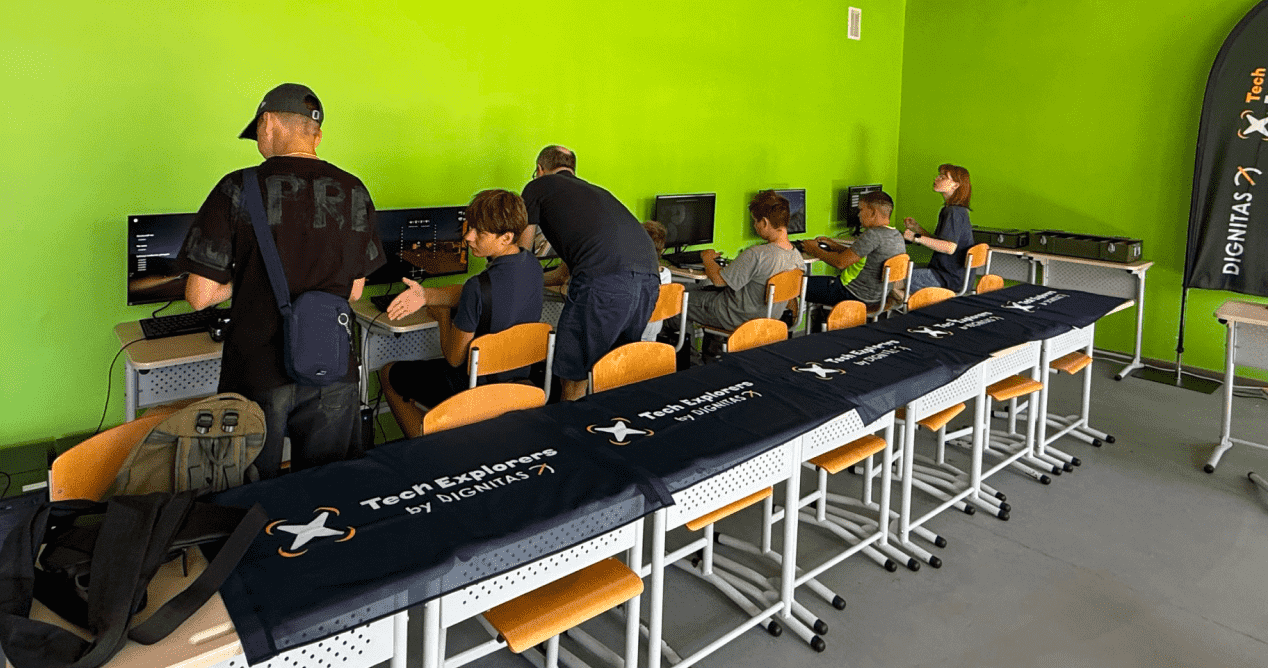
Dignitas Ukraine has been directly involved in supporting the development and deployment of this capability ecosystem through the Freedom Sky initiative, which focuses on protecting civilian infrastructure from drone-based aerial threats. The program combines specialized operator training with technology integration support, connecting the people who fly these systems with the engineers who build them.
To date, 476 interceptor drone operators have completed training through Freedom Sky — a number that represents not just individual skill development, but a growing human infrastructure capable of defending communities at scale.
Frequently Asked Questions
What is an interceptor drone and how does it differ from a regular military drone? An interceptor drone is a purpose-built unmanned aerial vehicle designed specifically to detect, pursue, and neutralize other drones in flight. Unlike reconnaissance drones (which gather information) or strike drones (which attack ground targets), interceptors are optimized for speed, maneuverability, and air-to-air engagement. They carry a small warhead or use kinetic impact to disable incoming aerial threats.
Why are Ukrainian interceptor drones so affordable compared to traditional air defense? Ukrainian interceptors are designed around commercial-off-the-shelf components, 3D-printed structural elements, and lean manufacturing processes developed by agile startups rather than large defense contractors. This keeps unit costs between $1,000 and $3,000 — compared to hundreds of thousands or even millions of dollars for a conventional surface-to-air missile interceptor. The result is a cost-asymmetric solution that can be produced and deployed at scale.
Which Ukrainian interceptor drone is the fastest? Based on publicly available specifications, the Sting-II and UEB-1 are currently the fastest platforms in the portfolio, both reaching speeds of up to 315 km/h. The Bullet follows closely at 314 km/h.
Which interceptor drone carries the largest warhead? The Octopus-100 carries the heaviest payload in the published portfolio at 1.2 kg, followed by the Tenebris Bagnet and TYTAN, both at 1.0 kg.
Are any of these drones developed in international collaboration? Yes — several platforms reflect active international partnerships. The Tenebris Bagnet was developed with French partners, the Octopus-100 with British collaboration, the Eagle Merops with American involvement, and the TYTAN with German engineering input. This international dimension underscores how Ukraine’s interceptor expertise has become a genuine hub for global defense innovation.
How are interceptor drone operators trained in Ukraine? Dignitas Ukraine’s Freedom Sky initiative provides specialized training for interceptor drone operators, combining technical instruction with hands-on simulation and field preparation. To date, 476 operators have completed this training program, forming a growing human infrastructure capable of protecting communities from aerial threats.
Are other countries interested in Ukrainian interceptor drone technology? Significantly so. According to Ukrainian government sources, at least 11 countries have submitted inquiries about Ukrainian interceptor platforms. Ukrainian operator teams have already been deployed to several countries in the Middle East to help build local aerial defense capabilities — reflecting the global relevance of what Ukraine has developed under real operational conditions.
What is the role of AI in Ukrainian interceptor drones? Several platforms, including the UEB-1 developed by OSIRIS AI, already incorporate artificial intelligence for autonomous target tracking and identification. Most Ukrainian manufacturers are actively integrating AI systems to allow drones to detect, lock onto, and pursue targets with reduced reliance on manual operator input — a development that significantly increases intercept effectiveness at scale.