Skip to content

November 8 — National STEM/STEAM Day
When people think about education in wartime Ukraine, they often imagine disruption: schools relocated underground, lessons interrupted by air raid sirens, children growing up in uncertainty. That picture is real. But it’s incomplete.
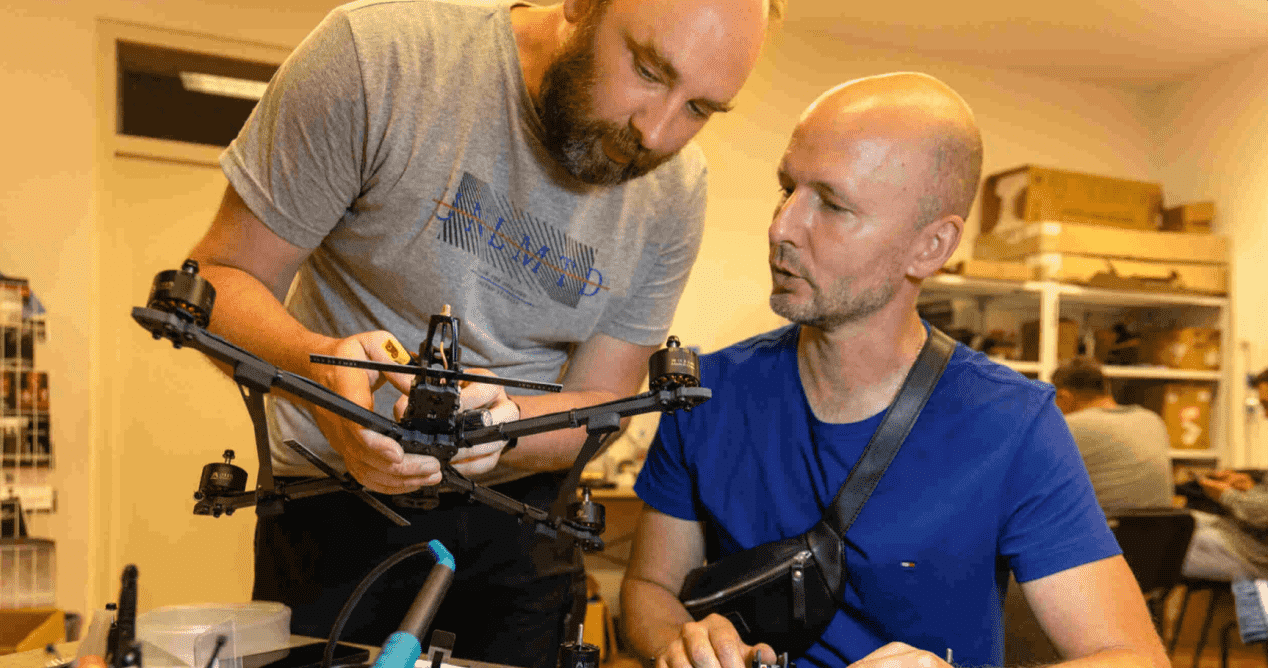
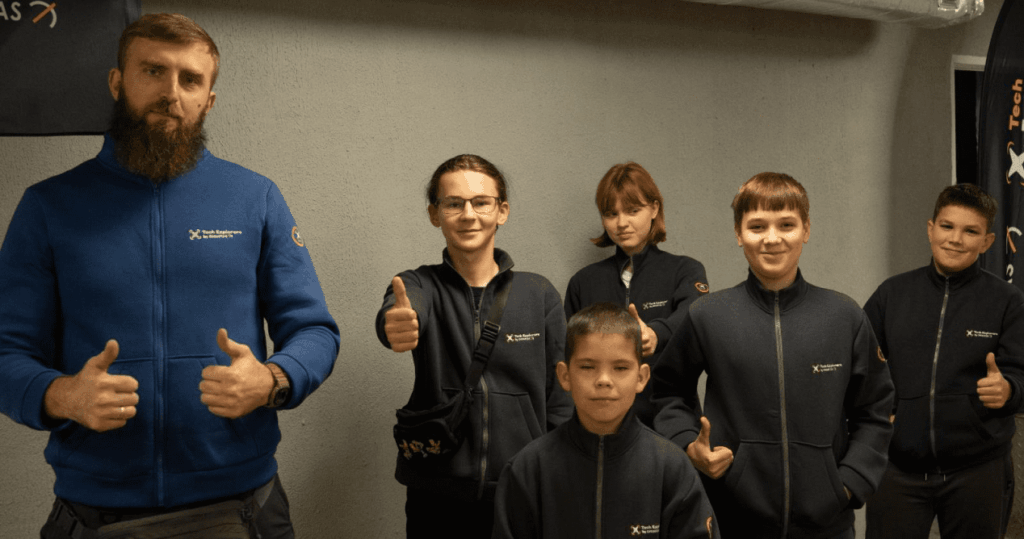
Across seven locations in Ukraine, a different story is unfolding. Children between the ages of 7 and 17 are assembling FPV drones, practicing flight in simulators, building circuits, and competing against each other in skill challenges — all under the guidance of instructors who made a quiet decision to invest in the next generation, whatever the circumstances.
This is Tech Explorers, Dignitas Ukraine’s free STEM education program. On National STEM Day, we want to introduce you to the people inside it.
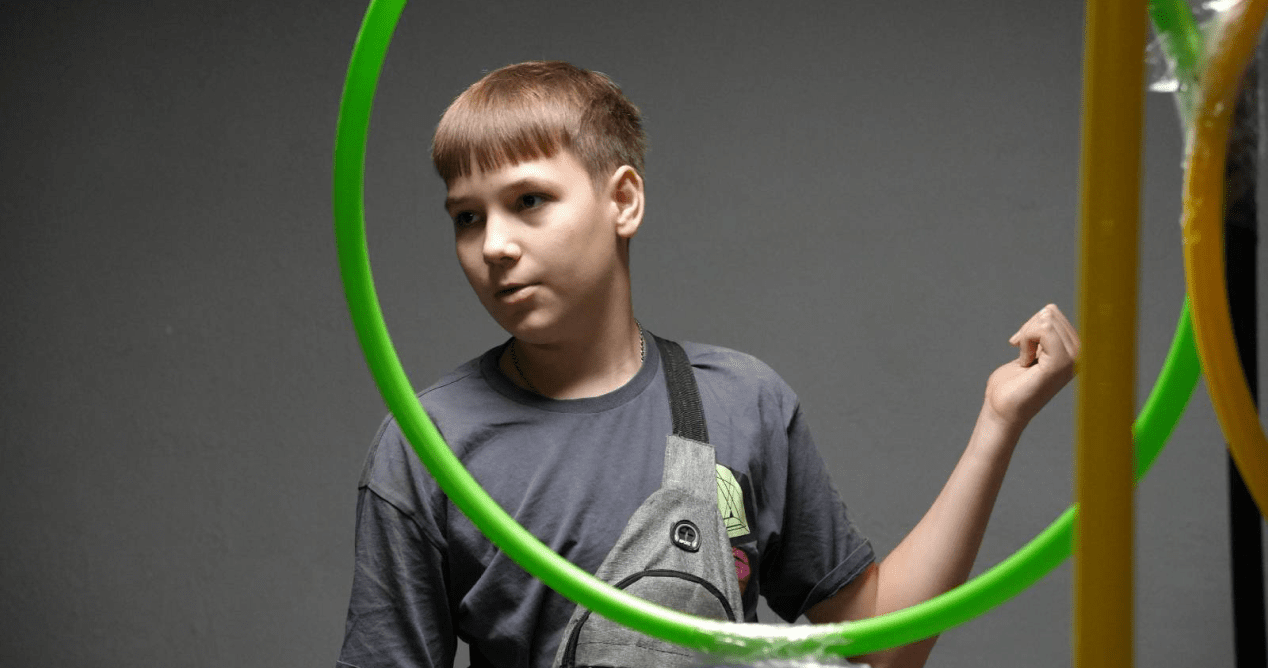
A Student Who Didn’t Expect to Care About the Future
Before he found Tech Explorers, Eduard’s days looked like many teenagers’ days: computer games, no particular plans, a vague sense that the future would figure itself out.
He found out about the program through a Facebook post his mother noticed — a drone school was opening. She asked if he wanted to try. He said yes, more out of curiosity than conviction.
That first lesson recalibrated something.
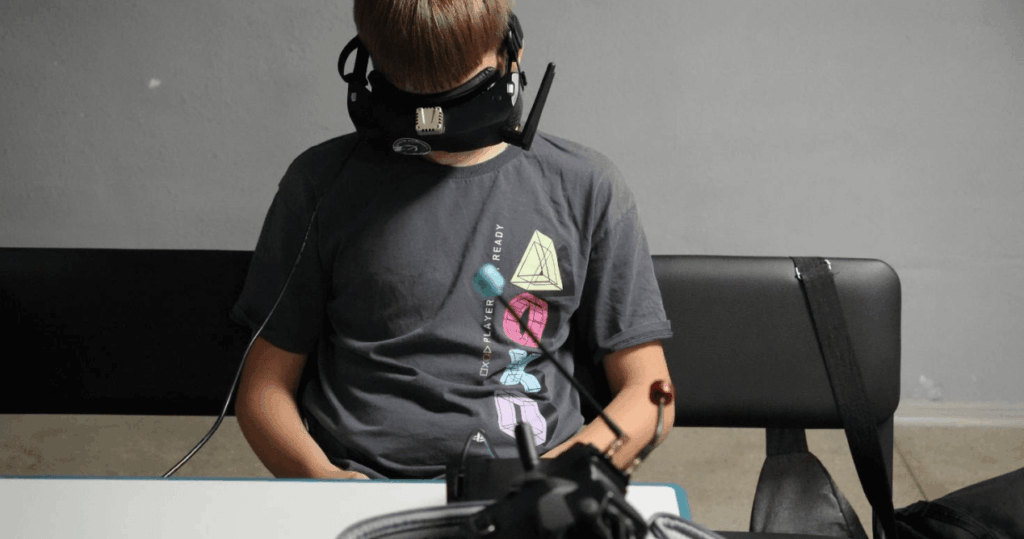
“I thought controlling a drone would be pretty easy,” Eduard says. “Then I picked up a real controller for the first time, and I couldn’t get it off the ground.”
The simulator had felt intuitive. The physical drone didn’t. That gap — between assumption and reality — was the first real lesson. He came back.
Several months in, FPV has become something Eduard describes simply: he’s good at it, he enjoys it, and he wants to keep getting better. He’s competed in tournaments. He’s made friends he wouldn’t have otherwise met. His family, he says, is happy he found something he genuinely loves.
What strikes him as important, though, is that his path to the program had nothing to do with the conflict outside. “I’m doing this not because of the times,” he says. “I do it because I find it interesting.”
That distinction matters. For a generation of Ukrainian children growing up surrounded by heavy context, Tech Explorers offers something uncomplicated: a skill, a community, and the pleasure of getting better at something you chose yourself.
The Instructor Who Measures Success by the Clock
Before Oleksandr started teaching drone piloting, he spent years in two parallel careers: as a teacher of defense and civil protection, and as a repair engineer working on technical systems. Neither, on its surface, pointed directly toward working with children and FPV drones.
Then a chance encounter changed the direction. During an open lesson — students practicing drone flights on a school sports field — he was approached by a Tech Explorers coordinator who had been watching. A conversation started. A proposal followed: help us build a drone school in your city.
Oleksandr said yes. And quickly found that all those years of technical knowledge and teaching experience didn’t just transfer — they combined into something more useful than either had been separately.
“I didn’t expect anything,” he says of the first lesson. “I wanted to understand the children, their level, their interest. What I didn’t expect was how engaged they were from the very beginning. Some of them showed impressive results after just a few sessions.”
His approach is methodical and individual. With younger children, he doesn’t overload them with technical vocabulary. He watches how each child moves, what captures their attention, where their natural strengths emerge. He uses game scenarios, competitive elements, adapts tasks to each student’s interests. “My goal is not just to pass on knowledge,” he explains. “First of all, to engage and motivate.”
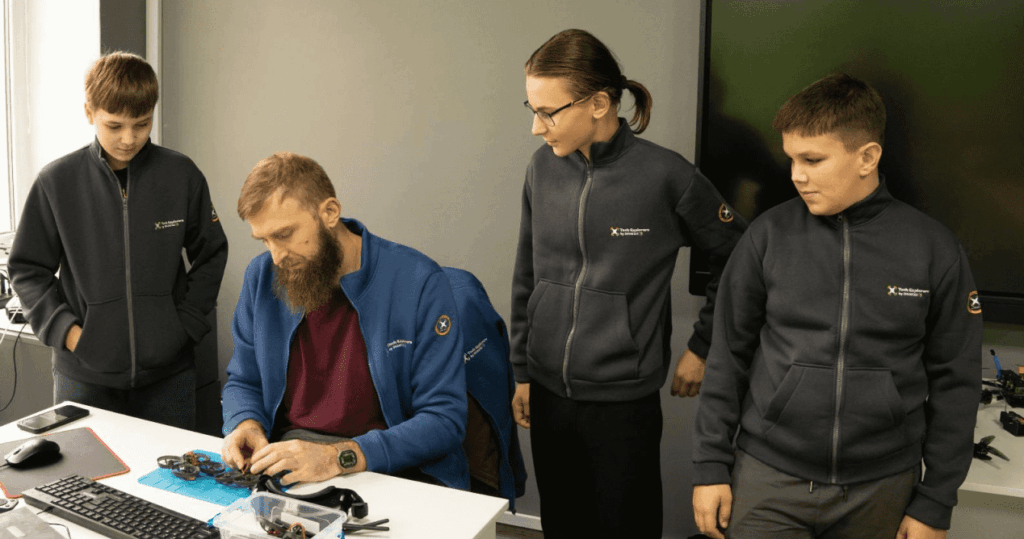
His measure of a successful lesson is simple: when he announces that time is up, the children don’t want to leave. After class, they continue talking in the school’s group chat — sharing what they tried, what worked, what they want to attempt next.
“All on pure enthusiasm,” Oleksandr says. “For me, that’s the sign of a good lesson.”
One student has stayed with him more than any other — Eduard, the same teenager whose story opens this article. He joined the program and from the very first session showed an unusual combination of enthusiasm and technical aptitude. He practiced at home, asked for extra materials, kept pushing further than the curriculum required.
Within a year, Eduard was assembling, repairing, and configuring drones independently. Today he works as an assistant engineer alongside Oleksandr and serves as a junior instructor in the school — helping his father, who serves in the Ukrainian armed forces, with drone-related knowledge along the way.
“I didn’t expect that at 14 it was possible to reach that level,” Oleksandr says. “His story is a clear example of what a child can achieve through their own motivation and genuine passion for technology.”
Oleksandr is honest about what the work means in this moment. He wishes the children could experience FPV purely as sport — for speed, precision, competition, joy. He holds onto that vision. In the meantime, he shows up, keeps the environment warm and the standards high, and treats every child with the same thing: respect, trust, and belief in what they can become.
What Happens Inside a Tech Explorers Lesson
The program runs across two age groups — children 7 to 12, and teenagers 13 to 17 — with curriculum calibrated to each.
Younger students work on foundational STEM skills: understanding how things work, building basic mechanical intuition, taking their first steps in coding and electronics. Older students go further — into advanced engineering concepts, drone assembly, flight simulation, and competition preparation.
A typical session might begin with simulator practice before moving to live drone flight. Students work in rotation, observe each other, debrief. Instructors are trained not just in the technical content but in how to read a room of children with very different backgrounds, some of whom are processing the absence of a parent on active duty.
That human dimension is built into the program’s design. Tech Explorers specifically targets children of military personnel and families affected by the conflict — not to center the difficulty, but to offer a community where children feel capable, engaged, and surrounded by peers who understand their reality without needing to explain it.
How Tech Explorers Is Growing
In October 2025, Dignitas Ukraine’s Tech Explorers program reached 383 children across 7 locations throughout Ukraine. The program organized 4 competitions to develop skills and build community engagement.
The program operates at no cost to families. Dignitas Ukraine covers equipment, instruction, and materials — funded entirely by donor support.
Frequently Asked Questions
What is Tech Explorers?
Tech Explorers is a free STEM education program run by Dignitas Ukraine for Ukrainian children ages 7 to 17. In October 2025, the program reached 383 children across 7 locations in Ukraine. The curriculum includes FPV drone piloting, engineering fundamentals, drone assembly, and competitive challenges.
Who can participate in Tech Explorers?
The program is open to children across participating locations in Ukraine, with particular focus on children of military personnel and families affected by the conflict since 2022.
What do students actually learn?
Younger children (7–12) build foundational STEM skills and technical curiosity. Older students (13–17) move into advanced topics including drone assembly, flight operations, electronic systems, and competitive piloting.
Does Tech Explorers cost anything for families?
No. The program is fully funded by donors and free for all participants.
How does STEM education connect to Ukraine’s defense needs?
Drone technology, engineering literacy, and technical problem-solving are central to Ukraine’s ability to defend itself and rebuild. Tech Explorers trains the next generation of people who will design, operate, and innovate in these fields — in both defense and civilian contexts.
How can I support Tech Explorers?
Your donation to Dignitas Ukraine directly funds program equipment, instructor training, and competition events. Support the program here → https://dignitas.fund/blog/ukraine-independence-day-2026-35-for-the-future-of-techexplorers/