Skip to content

Long gone are the days of black-and-white war footage showing large aircraft dropping bulky bombs high in the sky. Now you’re more likely to see TikTok videos of car-sized drones, sounding like old motorcycles, flying low over apartment buildings loaded with explosives. Drones like these, especially Shahed variants, have haunted Ukrainian skies throughout the Russian invasion, hitting apartment buildings, power grids, and military targets. But using expensive air defense missiles against Shaheds makes no economic sense for Ukraine.
Why, you might ask?
Shahed drones cost around $35,000 to $50,000, while air defense missiles, even small ones launched from fighter jets, cost hundreds of thousands of dollars. Ukraine desperately lacks such missiles, making each one even more precious. This is what makes Shahed drones so dangerous: they cost a fraction of what it takes to shoot them down, allowing enemies to launch hundreds simultaneously, day after day. Ukrainian cities now regularly face attacks by hundreds of Shaheds, with nationwide attacks reaching 800-1,000 drones per night. No amount of missiles or aircraft can defend against such daily and weekly attacks.
Ukraine needs cheaper, faster, easier methods.
And Ukrainians didn’t just sit and watch drones blow up hospitals and factories. They got creative.
Mobile air defense units roamed the country in pickup trucks mounted with machine guns, hunting drones by sight and sound. Amateur pilots and retired veterans flew private aircraft and old trainer planes, shooting down drones mid-air. Air defense units used electronic tools to jam drone controls and GPS to knock them off course. Ukraine also deploys expensive methods like portable missiles, anti-aircraft tanks, and fighter jets, but these forces must defend critical areas and can’t cover the entire country roughly the size of Texas.
Yet it wasn’t enough.
Soldiers and weapons are needed at the frontlines while russia ramps up nightly attacks. New Shahed versions fly faster and higher, beyond machine gun range. Russian drones slip through the defenses and hit their targets. Power grids suffer repeated damage. Apartment buildings keep getting hit, with hundreds of civilians killed and injured in their sleep every month.
Ukraine needs a new approach addressing two problems: lack of manpower and better ways to knock enemy drones from the sky.
The solution: the “people’s” air defense.

Live monitoring screen displaying 127 Shahed drones detected over Ukraine’s sky on August 20, 2025
Creation of Ukraine’s Civilian Volunteer Air Defense
In June 2025, Ukraine made it official: if you couldn’t be drafted but wanted to fight invading drones, now you could. Government Resolution No. 699 created rules for civilians to arm themselves, undergo training, and protect their communities from enemy drones as part of the national Air Defense network. Elderly men over 60, young people under draft age, women, and veterans who’d been medically discharged (often with injuries from earlier fighting) had a way to defend their neighborhoods. Most importantly, volunteers have flexibility to take volunteer defense duty shifts while continuing their civilian jobs.
Within just the first month, around 300 people reached out to the Armed Forces, ready to sign up.They were grandparents tired of watching drones hit their neighborhoods, injured veterans who couldn’t fight on the frontlines anymore but refused to sit idle, and young Ukrainians looking to do something other than hide in shelters every night.
Before June 2025, civilians had been informally offering their help, their equipment, their time, but there was no legal framework for them to participate and no benefits for their committed time. Worse, their families had no protection if their loved ones were seriously injured or killed while defending their communities. Now there was structure and safety. Volunteer air defense units operate under commanders from Ukraine’s Territorial Defense who are active service members. All activities – launching interceptor drones, flying private planes, firing machine guns – are strictly coordinated with local air defense units to ensure both safety and effectiveness. This model lets communities defend themselves without requiring large numbers of military personnel and equipment sitting idle nationwide between attacks, freeing up critical military resources for frontline operations and critical areas where they’re desperately needed.

Ukraine’s crew piloting an interceptor drone
Equipping Civilians with Interceptor Drones
Ukrainian engineers developed their own response to enemy drone attacks: cheap, fast interceptor drones. These specialized FPV (first-person view) drones race toward incoming Shaheds at high speed, then either ram into them or detonate a small explosive charge nearby to destroy them mid-flight. The pilot sits safely on the ground wearing goggles or watching monitors that show a live video feed from the drone’s camera, steering the interceptor like a tiny missile hunting down incoming Shaheds. Newer interceptor models can now reach the latest Shahed versions that fly higher and faster, and the technology continues to rapidly improve.
However, interceptor FPV drones come with challenges: unlike regular FPV drones that hover steadily, FPV drones fly fast and aggressively. Tracking and hitting a target moving at 300 km/h (~190 mph) or faster in the dark requires serious skill and lots of practice.
This is where veterans step in. Injured soldiers who flew FPV drones in combat already have the piloting skills needed. They can step in immediately and start hunting Shaheds. And these veterans have civilian volunteers as their crew: people to assemble and maintain the drones, spot incoming targets, coordinate with other air defense units, and transport equipment. Elderly volunteers, young tech enthusiasts, and women can all fill these support roles, making interceptor teams a true community effort.
The technology is rapidly improving, with Ukrainian startups leading the charge. At $1,000 to $5,000 per interceptor compared to $35,000+ for a Shahed, the economics heavily favor Ukraine. The Defense Procurement Agency now contracts with over 10 manufacturers, ensuring a steady supply. These aren’t billion-dollar defense corporations but agile Ukrainian startups working directly with frontline pilots to iterate and adapt quickly.
Interceptor Drone Startups to Watch:
- Skyfall – P1 SUN: Reaches altitudes up to 5,000 meters and speeds up to 450 km/h (280 mph).
- WildHornets – Sting: Costs roughly $2,500, capable of taking down Shaheds at 300 km/h (~190 mph).
- GenCherry – Bullet: Anti-Shahed interceptor FPV drone designed specifically for aerial interception, also at 300 km/h (~190 mph).

WildHornets’ Sting interceptor drone ready for take off
Building the People’s Air Defense
Ukraine’s civilian volunteer air defense program is about building a complete ecosystem where communities, businesses, and expert organizations work together to build a nationwide air defense network. But the implementation is complex and flexible, adapting to each community’s unique resources and needs. Local communities and their governments can create their own programs to fund and recruit volunteers. Businesses and civil society organizations can supplement with funding and expertise, especially in communities that lack resources. Large businesses or critical infrastructure operators like factories and power grid facilities can even create their own dedicated air defense units, registering them as volunteer formations to protect their assets while also contributing to national air defense.
How Communities Can Equip Local Defense Teams:
Communities play a crucial role by funding and providing the essentials their volunteer teams need to operate effectively. This includes purchasing interceptor drones from Ukrainian manufacturers, setting up reliable communications systems and power supplies to keep operations running during blackouts, and ensuring teams have mobility (vehicles), shelters for equipment and personnel, and the logistics support needed for sustained operations. The approach is highly scalable and adaptable. A small town might fund one interceptor team through local government budget allocations, while a large city could support dozens through a combination of municipal funding, business sponsorships, and crowdfunding. Each team protects their own neighborhoods, creating a distributed defense network across the country.
Partnering with Nonprofit and Expert Organizations:
Training volunteer crews and coordinating operations requires expertise that most communities lack, while military training schools are overcapacity and their programs don’t cover emerging technologies like interceptor drones. This is where nonprofit organizations like Dignitas step in. Such nonprofits can support local volunteer air defense groups with:
- Crew Formation & Training: Building interceptor crews from scratch: navigating legal paperwork and licenses, connecting with Territorial and Air Defense units, and providing expert trainers to develop volunteers’ skills, especially drone piloting. Aspiring FPV pilots can attend specialized training schools operated by nonprofits.
- Equipment & Support: Guidance on selecting interceptor drones, systems, and verified suppliers. Funding assistance to purchase drones and essential gear. Building supply chains to ensure teams always have access to supplies.
- Operational Coordination: Designing complete defense strategies tailored to each community’s unique threats and resources: team structures, role distribution, funding plans, command center and workshop locations, power supplies, and positioning of defense crews.

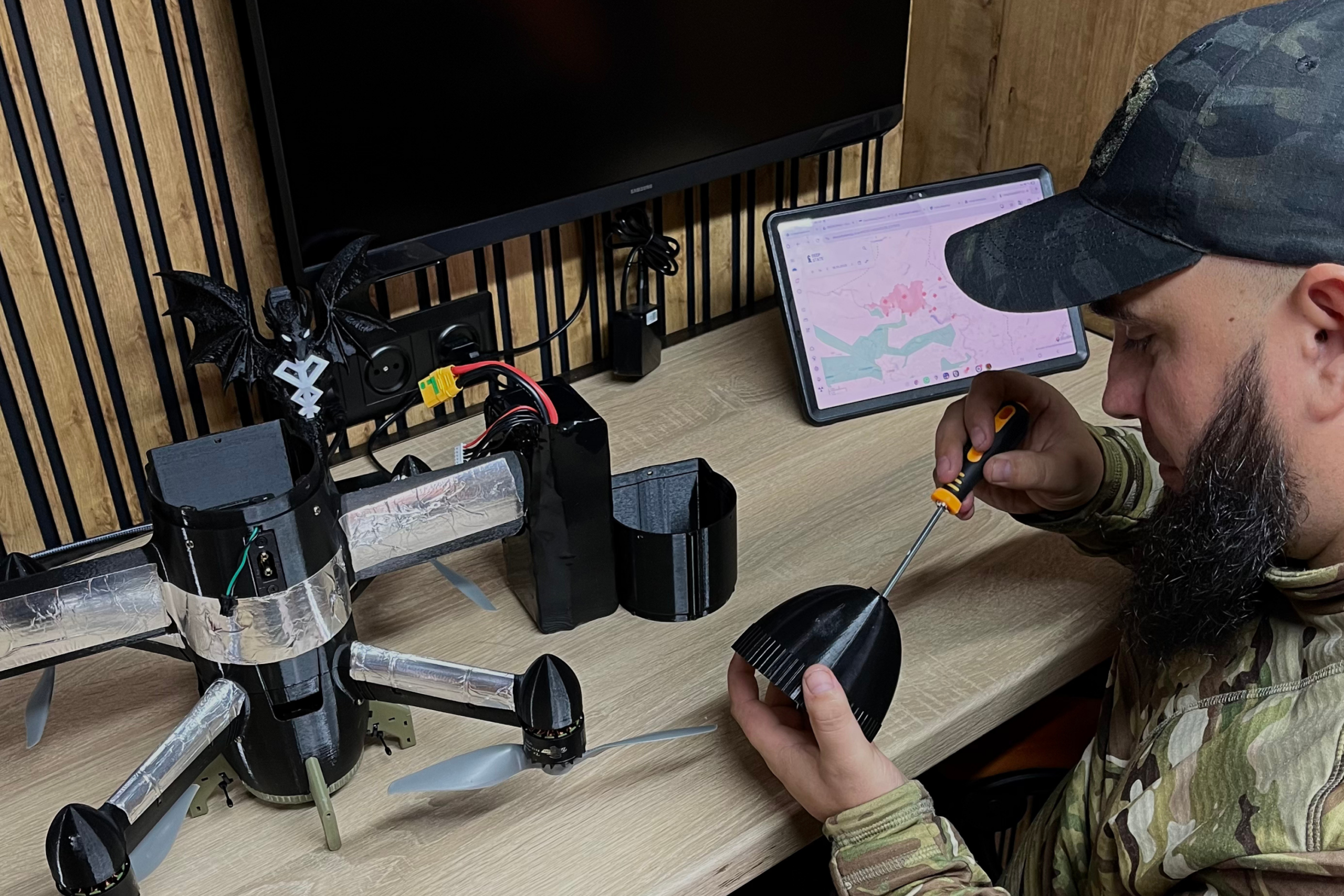
Loading an explosive payload onto a Sting interceptor drone
Dignitas’ Freedom Sky Initiative
Dignitas is leading the effort to build Ukraine’s people’s air defense through its FreedomSky initiative. The organization provides end-to-end support for communities and businesses looking to establish local interceptor drone teams, from crew formation and training through equipment procurement and operational coordination. FreedomSky aims to create a nationwide network of community-based air defense capabilities that operate independently while integrating seamlessly with military command structures. By standardizing training protocols, equipment recommendations, and legal frameworks, Dignitas is making it possible for any Ukrainian community to protect its own skies.
Learn more or get involved:
Visit https://dignitas.fund/freedomsky/ or contact freedom_sky@dignitas.fund to explore how you can support building Ukraine’s civilian air defense.