Skip to content


1. What Is the Kill Zone?
The “kill zone” is what Ukrainian defenders call the stretch of terrain immediately behind the front line — roads, fields, and abandoned villages where aerial drones hunt anything that moves. It is not the contact line itself. It is the space approaching it, and it has become as dangerous as anywhere in the conflict.
In this zone, Russian reconnaissance drones track vehicle movements in real time. Fiber-optic FPV drones are positioned along road approaches, immune to jamming. Guided aerial munitions — Soviet-era bombs fitted with control systems — can strike targets from over 100 kilometers away, specifically directed at suspected drone crew positions. The kill zone has extended the threat radius far beyond the front line and forced a complete rethinking of how defenders move, supply, and operate.
In summer 2025, Dignitas Ukraine’s co-founder and CEO, Lyuba Shipovich, and team member Stepan Nehoda traveled to this part of Ukraine alongside Ukrainian-American journalist David Kirichenko. Together they met robotics units and defenders on the Lyman front, observing ground robots in operation and witnessing firsthand how unmanned systems have changed the conditions defenders face. What followed — Kirichenko’s embedded report from inside a drone unit’s forward position, published by Harvard University’s Ukrainian Research Institute — is among the most detailed firsthand accounts of frontline drone operations published to date. This article draws on that report to explain what the kill zone looks like today, and why the training work Dignitas programs deliver is inseparable from the survival of the people operating inside it.
2. Embedded with Ukraine’s Drone Units: What the Dignitas Team Witnessed
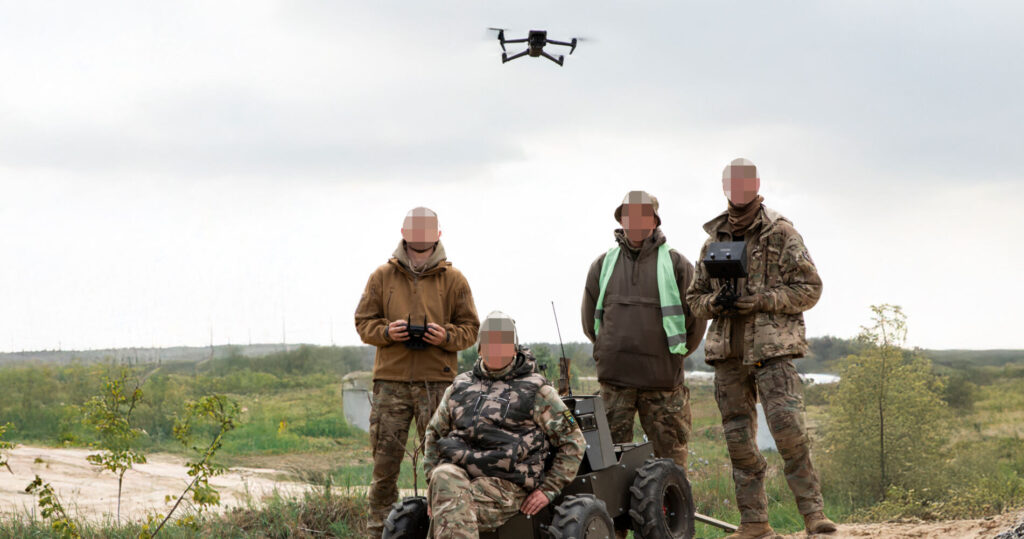
Kirichenko embedded with the Unmanned Systems Battalion of Ukraine’s 110th Separate Mechanized Brigade — a unit integrating aerial FPV drones, reconnaissance platforms, electronic warfare systems, and coordinated artillery into a single defensive operation.
The journey to the forward position illustrated the stakes before anything else happened. GPS signals dropped as Russian drones conducted jamming operations overhead. The route to the position required careful routing across broken terrain, avoiding main approaches monitored by Russian reconnaissance. Vehicles were fitted with welded metal cages and improvised armor plating — improvised protection against the FPV drone strikes that have made standard vehicle movement through the kill zone extremely hazardous. Arriving required a 45-minute drive in darkness with headlights off, the driver navigating on memorized routes using night-vision equipment.
At the forward position, the team operated from underground bunkers beneath tree cover. Throughout the day, Russian guided aerial munitions struck the surrounding area in sustained waves. The targeting logic is deliberate: drone crews have become high-priority assets, and opposing forces direct high-value precision munitions specifically at their suspected positions. The cost-benefit math reflects the stakes — a drone team neutralized can shift battlefield dynamics across a wide sector.
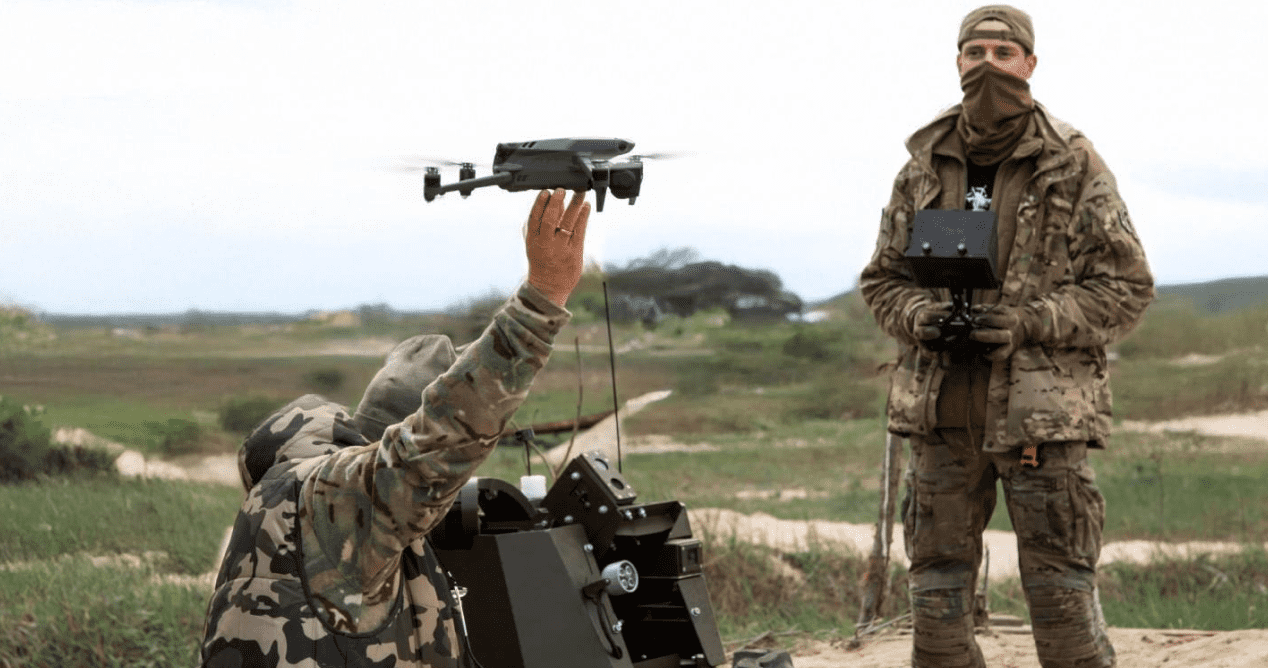
During the Dignitas team’s broader visit to the front, they witnessed this shift most clearly through ground robotics. Near Kostyantynivka, roads approaching the front line were described as effectively impassable for standard logistics — littered with destroyed equipment, watched from above, dangerous at any speed. In some sectors, wounded defenders had remained isolated for extended periods, reachable only by aerial drone delivering medical supplies. The ground robots Dignitas Ukraine’s Victory Robots program trains operators to use were not an experiment in this environment. They were the only viable option.
3. The Technology Stack: FPV Drones, Mavics, and Fiber-Optic Systems
Modern frontline drone operations involve multiple platform types operating in coordination. Understanding each one is essential to understanding why trained operators matter.
FPV (First-Person View) drones are small, fast, and carry an explosive payload guided to a target through a pilot’s live video feed. Before launch, each FPV undergoes precise explosive attachment and careful wiring inspection — procedural failures have cost operators severe injuries. Flight time from launch to target ranges from seven to ten minutes, requiring the pilot to maintain continuous signal contact and adapt to a target that may have moved multiple times before the drone arrives.
Mavic-class reconnaissance drones serve as the eyes of the operation. They locate targets, track movement across terrain, and guide FPV pilots onto objectives they cannot otherwise identify. Without a Mavic maintaining visual on a target, an FPV pilot may navigate to a position only to find trees and open fields. The two systems depend on each other.
Fiber-optic drones represent a newer and particularly dangerous threat category. Unlike radio-frequency drones that can be detected and disrupted by electronic warfare systems, fiber-optic platforms communicate through a physical cable laid behind them as they fly — making them resistant to standard jamming techniques. These drones have been positioned along road approaches across multiple front sectors, waiting as the conflict’s most difficult-to-counter short-range threat. They require detection and response approaches fundamentally different from those developed for radio-controlled platforms.
Guided aerial munitions — modified Soviet-era bombs fitted with wing kits and control systems — add a long-range precision dimension. Capable of being released from aircraft at altitude and gliding to targets over 100 kilometers away, they are deployed against positions, infrastructure, and — specifically — suspected drone crew locations.
4. Combined-Arms Drone Warfare: A New Tactical Doctrine
What the 110th Brigade’s drone unit demonstrated is not single-platform operation. Ukrainian drone teams have developed and refined a combined-arms doctrine that integrates multiple systems into a coordinated approach.
A Mavic reconnaissance drone locates and maintains visual on a target. Artillery can respond in under a minute once a firing solution is established. FPV drones are deployed when precision or persistence is required — when a target is moving or when an artillery effect needs confirmation and follow-through. Defenders on the contact line coordinate with drone teams positioned further to the rear, with the entire sequence compressed into windows of seconds to minutes.
The economics of this doctrine are significant. According to Ukraine’s commander of Unmanned Systems Forces, Robert “Magyar” Brovdi, Ukrainian drone units spend approximately $40 million monthly on unmanned systems while generating an estimated $4 billion in damage to opposing forces — a ratio that reflects both the cost-effectiveness of the approach and the scale at which it is being executed. Brovdi has also noted the cost of neutralizing a single Russian infantryman through drone operations at approximately $882.
This tactical effectiveness is why drone operators have become priority targets. When a drone team is neutralized, the combined-arms coordination it enables collapses across its operational sector. That is the military logic behind directing high-value precision munitions at a small team in a bunker.
The coordination Kirichenko documented is demanding under any conditions. Multiple drone feeds run simultaneously. Radio traffic moves in multiple directions. Targets shift, signals cut out, artillery is calling for handoffs. An FPV pilot tracking a motorcyclist moving at speed through smoke — the scenario Kirichenko witnessed — is managing a seven-to-ten-minute flight window against a target that may have changed direction multiple times. When coordination works, the effect is decisive. When it breaks down, the target escapes.
5. Electronic Warfare: The Invisible Battleground
The kill zone is simultaneously a drone operations environment and an electronic warfare battleground. Ukrainian units operate jamming and detection systems designed to disrupt opposing drone communications, force platforms into failsafe modes, and deny opposing operators the signal connection their drones depend on.
At the position Kirichenko visited, an electronic warfare team from an adjacent unit monitored drone activity using a system called “Damba,” designed to detect and disrupt drone signals across the local airspace. The constant electronic environment has changed how defenders experience the front at a fundamental level. Sleep patterns adapt to the noise of the systems running around the clock. The disorientation of an unidentified sound — a drone, a munition, a generator — without the ability to locate its direction is described by defenders as one of the most psychologically demanding features of sustained frontline operation.
This electronic dimension is directly connected to Dignitas Ukraine’s Freedom Sky program. Freedom Sky trains defenders to detect, track, and neutralize aerial threats — including the Iranian-designed Shahed drones used in mass attacks on Ukrainian cities and infrastructure. The detection skills, system operation techniques, and threat-identification capabilities that Freedom Sky develops are the same capabilities that keep defenders and civilians alive in the electronic environment of the kill zone. With 476 operators trained through the program, Freedom Sky represents a sustained contribution to Ukraine’s distributed aerial defense capacity.
The connection between defensive aerial capability and frontline survival is direct. Ukrainian air defense has become one of the most adaptive and comprehensive systems in the world — validated under real operational conditions against peer-level threats, continuously refined through battlefield experience. The operators who contribute to that system at every level begin with training.
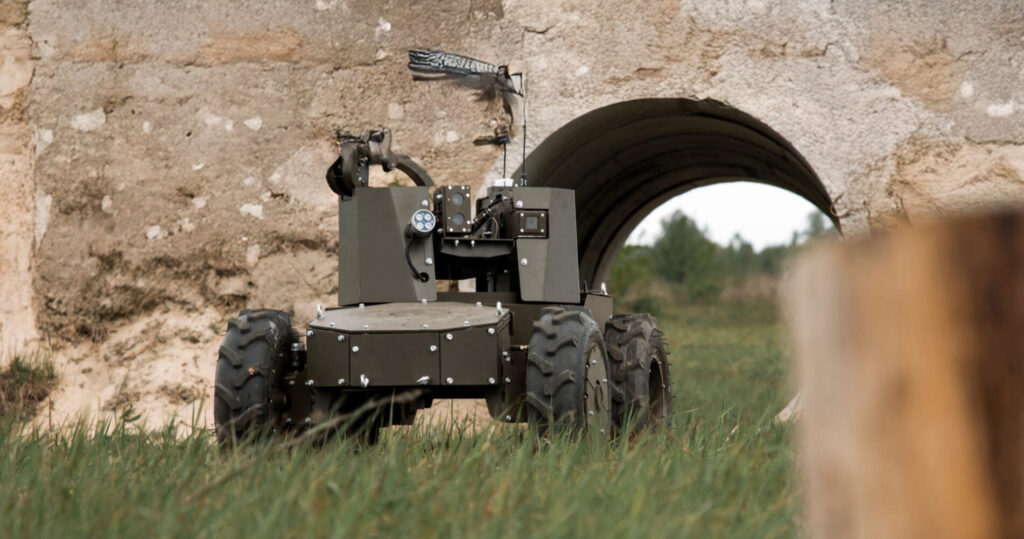
6. Ground Robots: Saving Lives Where Humans Cannot Go
Among the most significant shifts documented across Kirichenko’s reporting and the Dignitas team’s frontline visits is the role of unmanned ground vehicles (UGVs) — ground robots — in missions that would otherwise result in casualties or mission failure.
On roads approaching the front in sectors like Kostyantynivka, standard vehicle logistics have become nearly impossible. Roads are watched from above, mined from below, and approached through territory where any movement draws immediate drone attention. In some positions, wounded defenders have been isolated for extended periods, beyond the reach of conventional evacuation. Aerial drones have delivered medical supplies to these positions. Ground robots have crossed terrain that no vehicle could safely navigate.
Dignitas Ukraine’s Victory Robots program has trained more than 2,023 individuals in the operation of ground robotic systems. The mission these operators fulfill is precisely what Kirichenko and the Dignitas team witnessed: taking high-risk tasks off human hands, crossing mined roads and drone-watched kill zones to reach people who cannot wait.
The impact of a single UGV mission can be irreversible. In Dignitas Ukraine’s 2025 Impact Report, Serhii Volkov — a Victory Robots participant who now commands unmanned systems — described a mission where a severely wounded defender lay stranded at the front line with little chance of survival. A ground robot was deployed for evacuation. Behind the controls was a 19-year-old operator on her first mission. For six hours, through snow and freezing temperatures, across more than 30 kilometers of terrain, she guided the robot forward. The defender survived.
Without a trained operator, that mission does not happen. Without the training infrastructure Victory Robots provides, that operator is not there.
7. The Human Factor: Why Operator Training Determines Outcomes
The hardware of drone warfare is increasingly available. FPV components, Mavic platforms, electronic warfare systems, and ground robots can be sourced, assembled, and deployed with relatively modest resources compared to conventional military equipment. What determines outcomes is the skill, discipline, and judgment of the humans operating these systems under sustained pressure.
A skilled FPV pilot tracks a moving target through intermittent signal conditions, anticipates direction changes, and delivers a precise effect at the end of a seven-to-ten-minute flight window. An unprepared operator sends a drone into trees. A Mavic operator who understands fire coordination can compress an artillery response from minutes to seconds. One who does not misses the window entirely.
The drone team Kirichenko documented functions because every member executes a defined role under conditions of sustained stress: bombardment overhead, simultaneous feeds from multiple platforms, radio traffic across multiple channels, and the constant pressure of a rapidly changing tactical picture. Bohdan — the FPV pilot at the center of the account — explains the fundamental tension: a target moving through fields can change direction five times in the ten minutes it takes an FPV to reach it. The pilot must predict, adjust, and maintain control while also managing communication with the reconnaissance team, the artillery coordination, and the physical demands of the environment.
That capability is trained. It does not arrive with the hardware.
This is the foundation of Dignitas Ukraine’s Victory Drones program, which has trained more than 44,320 individuals in UAV operations — FPV piloting, drone engineering, UAV systems operation, and the coordination skills that make a drone team effective rather than simply equipped. Every operator in that program represents a trained decision-maker who understands not only how to fly a platform, but how to integrate it into the combined-arms operation that determines whether it produces an effect.
8. What Dignitas Programs Make Possible
The frontline reality Kirichenko documented — the kill zone, the bunker, the coordinated drone team holding a defensive line under sustained bombardment — is inseparable from the people who operate within it. And the people who operate within it begin with training.
Victory Drones provides training in UAV engineering, FPV assembly and operation, and the tactical integration skills that make individual operators effective within coordinated teams. More than 44,320 individuals trained represents a distributed network of capable operators deployed across Ukraine’s defense.
Victory Robots trains operators in the use of unmanned ground vehicles — the systems evacuating wounded defenders, delivering supplies, and performing demining operations in terrain no human can safely cross. More than 2,023 trained operators are building the human infrastructure behind Ukraine’s expanding ground robotics capability.
Freedom Sky trains defenders to detect and neutralize aerial threats — including the drone systems that make the kill zone lethal for anyone moving through it. With 476 trained operators, Freedom Sky contributes directly to the layered aerial defense capacity protecting Ukrainian cities, critical infrastructure, and frontline positions.
Flight to Recovery supports wounded veterans in rebuilding their lives through technology training and community. Anton Drombinskyi — a former video game designer who served as a communications specialist before being injured — joined Flight to Recovery as a participant and stayed on as an assistant. The 220 veterans who have completed this program carry the skills, confidence, and purpose to continue contributing to Ukraine’s future.
The story Kirichenko tells from inside the kill zone is a story about technology. But every drone in that bunker, every ground robot crossing a mined road, every electronic warfare system tracking signals across the kill zone is operated by a human being who knows what to do when it matters. Building that capability — one trained operator at a time — is what Dignitas Ukraine exists to do.
If you want to support this work, you can donate at dignitas.fund.
9. Frequently Asked Questions
What is Ukraine’s “kill zone” in drone warfare?
The kill zone refers to the stretch of terrain behind the front line where aerial drones, fiber-optic FPV systems, and guided aerial munitions make movement extremely hazardous. It extends the danger area well beyond the contact line, requiring specialized equipment, specific training, and coordinated tactics to navigate.
How do Ukrainian drone units coordinate multiple systems on the frontline?
Ukrainian drone units use a combined-arms approach: Mavic reconnaissance drones identify and track targets, artillery delivers rapid strikes once a firing solution is established, and FPV drones are deployed for precision effects when needed. Ground robots handle resupply and evacuation in terrain too dangerous for standard logistics. Electronic warfare systems protect the team’s communications while disrupting opposing drone operations.
What makes fiber-optic drones difficult to counter?
Fiber-optic drones communicate through a physical cable laid as they fly, rather than through radio frequencies. This makes them resistant to traditional electronic jamming — the countermeasure applied to most radio-controlled drone threats — requiring different detection approaches and responses.
Why are drone operators prioritized as targets in modern frontline operations?
Drone operators have become strategically decisive, capable of disrupting logistics, guiding artillery, and executing precision effects at scale. When a drone team is neutralized, the coordinated operation it enables collapses across its sector. Opposing forces have responded by directing high-value precision munitions specifically at suspected drone crew positions.
How does Dignitas Ukraine support Ukraine’s drone defense capability?
Through three main programs: Victory Drones (44,320+ individuals trained in UAV operations), Victory Robots (2,023+ trained in ground robotic systems), and Freedom Sky (476 operators trained to detect and neutralize aerial threats). A fourth program, Flight to Recovery, supports 220 wounded veterans in rebuilding skills and purpose through technology training.
What role do ground robots play in frontline operations today?
Unmanned ground vehicles (UGVs) perform resupply, evacuation, and demining missions in terrain that cannot be safely crossed by human personnel or standard vehicles. In sectors where aerial drones make road movement nearly impossible, ground robots have become the primary means of reaching isolated defenders and extracting those who need medical care.
Why is operator training more important than hardware in drone warfare?
Hardware is increasingly available and relatively affordable. What determines whether a drone system produces an effect under real conditions is the skill, judgment, and stress management of the trained operator behind it. A prepared FPV pilot coordinates a seven-to-ten-minute flight to a moving target under sustained pressure. An unprepared operator does not. Training is the variable that distinguishes one from the other.
Primary source: David Kirichenko, “Inside Ukraine’s Kill Zone, Where Drones Hunt Everything That Moves,” Harvard University Ukrainian Research Institute — Russo-Ukrainian War, July 21, 2026. war.huri.harvard.edu
David Kirichenko traveled to the front with the Dignitas Ukraine team, including co-founder and CEO Lyuba Shipovich and team member Stepan Nehoda, where together they met robotics units and frontline defenders. Lyuba Shipovich subsequently connected Kirichenko with the 110th Brigade’s Unmanned Systems Battalion for his embedded reporting.
Learn more about Dignitas Ukraine’s training programs: Victory Drones | Victory Robots | Freedom Sky | Flight to Recovery